



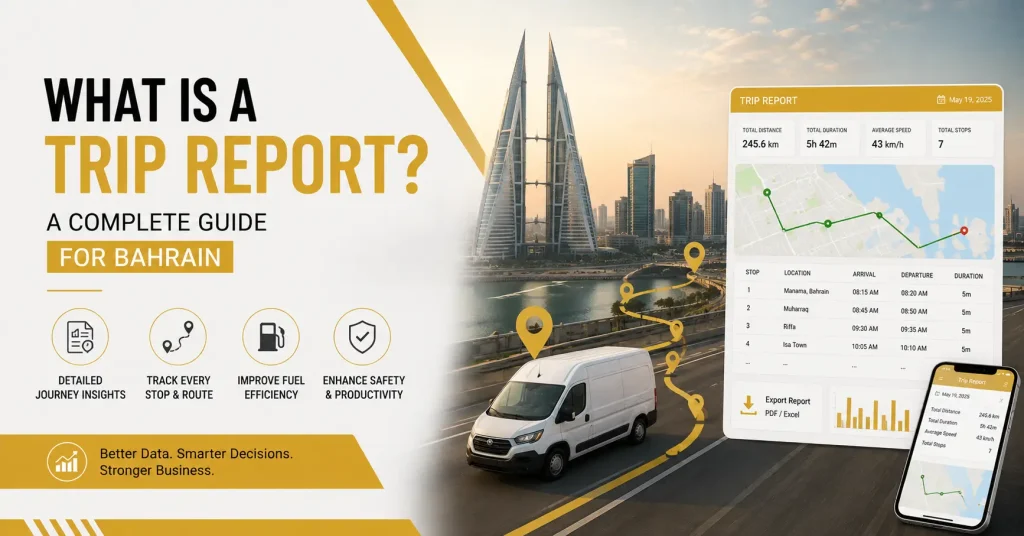
What is a Trip Report? A Complete Guide for Bahrain
Offer
Special Bahrain Offer – Get Premium GPS Tracking with Free Installation!
If you’ve ever had to answer the question where exactly did the car go today? without a real answer, you already understand the problem a trip report solves. Whether it’s a business trying to account for a fleet of delivery vehicles or a parent wanting to know if their teenager actually went where they said they would, guessing isn’t good enough.
What is a trip report? It’s a GPS tracking feature that turns guesswork into a clear, factual record. It’s one of the most valuable and often overlooked features of modern GPS tracking systems, helping vehicle owners and fleet managers across Bahrain monitor every journey with confidence.
In this guide, you’ll learn what a trip report is, how it works, and how it can benefit both personal vehicle owners and businesses.
If you’ve ever wondered what geo-fencing is, the answer lies in one of the most practical features of modern GPS tracking systems. It’s quickly becoming a must have for vehicle owners and fleet businesses across Bahrain. In this guide, we’ll explain what geo-fencing is, how it works, and why it matters whether you own a single car or manage a fleet of fifty.
Why Trip Reports Are Important
A trip report is a detailed, automatically generated record of everywhere a vehicle has traveled over a specific period of time. Instead of just showing where a vehicle is right now, a trip report shows where it has been including the exact route taken, start and end points, timestamps, distance covered, stops made, idle time, and often speed data throughout the journey.
Think of it as a digital logbook that writes itself. Every time the vehicle moves, the GPS tracking system quietly records the journey in the background, then compiles that information into an easy-to-read report you can review whenever you need it by day, week, month, or custom date range.
How Does It Work?
The process behind a trip report is straightforward, even though it relies on advanced GPS tracking technology.
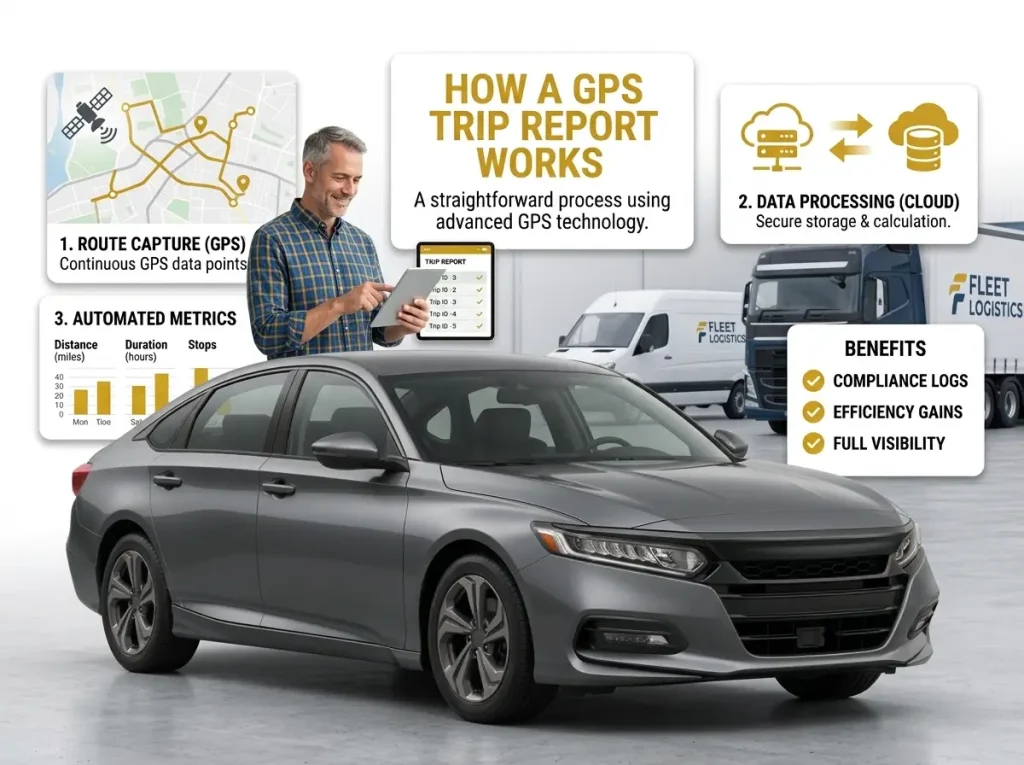
1. Continuous location logging
- The GPS device installed in the vehicle records its position at regular intervals as it moves, capturing latitude, longitude, speed, and timestamps.
2.Trip segmentation
The system automatically identifies where a trip starts (ignition on / movement begins) and ends (ignition off / vehicle stationary for a set period), breaking the day into individual, distinct journeys.
3. Data compilation
Each trip is compiled with key details: starting location and time, ending location and time, total distance traveled, duration, average and maximum speed, and any stops along the way.
4. Report generation
All of this is presented in a clear format, usually a combination of a visual route on a map and a structured summary accessible through the mobile app or web dashboard, and often exportable as a PDF or Excel file for record-keeping.
What Information Does a Trip Report Typically Include?
- Start and end location of each trip
- Departure and arrival times
- Total distance traveled
- Trip duration and idle/stoppage time
- Average and maximum speed
- The exact route taken, shown visually on a map
- Number of stops and their duration
Together, these details give a complete story of a vehicle’s movement, not just isolated data points.
Key Benefits of Trip Reports
Complete Transparency for Fleet Operations
For businesses managing multiple vehicles, trip reports remove the uncertainty around daily operations. Managers can confirm that routes were followed as planned, deliveries were completed on schedule, and vehicles weren’t used for unauthorized personal trips.
Better Route and Fuel Efficiency
Reviewing trip history over time makes it easy to spot inefficient routes, excessive idling, or repeated detours. Businesses can use this insight to plan smarter routes, reduce fuel consumption, and cut down on wasted driving hours, a meaningful saving when multiplied across an entire fleet.
Accurate Record-Keeping and Reporting
Trip reports provide a reliable, timestamped record that’s useful for client billing, mileage claims, maintenance scheduling, and internal audits. Instead of relying on driver-submitted logs, businesses get objective, system-generated data.
Dispute Resolution and Accountability
If a customer disputes a delivery time, or there’s a question about whether a vehicle was where it was supposed to be, a trip report provides a clear, factual answer protecting both the business and its drivers from unfounded claims.
Peace of Mind for Personal Vehicle Owners
For individual owners, trip reports offer a simple way to review how a vehicle has been used, useful for tracking a new driver in the family, monitoring a shared vehicle, or simply keeping a personal record of travel for expense or tax purposes.
Practical Uses of Trip Reports in Bahrain
For logistics and delivery businesses:
With Bahrain’s delivery and courier sector continuing to grow, trip reports help operators verify that drivers are completing routes efficiently and on time, providing solid data for both internal performance reviews and customer service commitments.
For construction and service companies:
Businesses that dispatch vehicles to multiple job sites across the island can use trip reports to confirm site visits, calculate accurate travel time for billing, and manage vehicle usage across teams.
For corporate fleets:
Companies managing pool cars or executive vehicles can use trip history to maintain clear usage records, support expense reporting, and ensure vehicles are being used appropriately.
For individual and family vehicle owners:
A trip report offers a simple, non-intrusive way to stay informed about how a shared or family vehicle is being used day to day, particularly useful for households with newer or younger drivers.
Why Choose Najoom Al Thuraya Bahrain
At Najoom Al Thuraya Bahrain, trip reporting is a core part of our GPS tracking platform, giving both individual owners and fleet businesses a clear, reliable record of vehicle activity without any manual effort. Our systems are backed by responsive local support, an easy-to-use mobile app, and a team based right here in Bahrain that understands the operational realities of running vehicles across the island from daily deliveries to family cars.
FAQ's
This depends on the tracking platform, but most systems, including Najoom Al Thuraya’s, allow you to review trip reports over custom date ranges from a single day to several months back directly through the app or dashboard.
Yes. Trip reports are typically available for download in common formats such as PDF or Excel, making them easy to share, file, or use for internal reporting and audits.
Not quite. Real-time tracking shows you where a vehicle is right now, while a trip report shows you where it has already been a historical record rather than a live view. A good GPS tracking system offers both.
Yes. Whether you’re tracking one personal car or managing dozens of fleet vehicles, trip reports scale to your needs, with fleet dashboards typically allowing you to compare trip data across multiple vehicles at once.
Conclusion
A trip report turns vehicle movement into usable information helping businesses run more efficiently, resolve disputes with facts instead of guesswork, and giving individual owners a clear picture of how their vehicles are being used. It’s a quiet but powerful feature that pays for itself many times over, whether you’re managing one car or an entire fleet.